Three Amazing Opportunities for Graphic Novel Creators

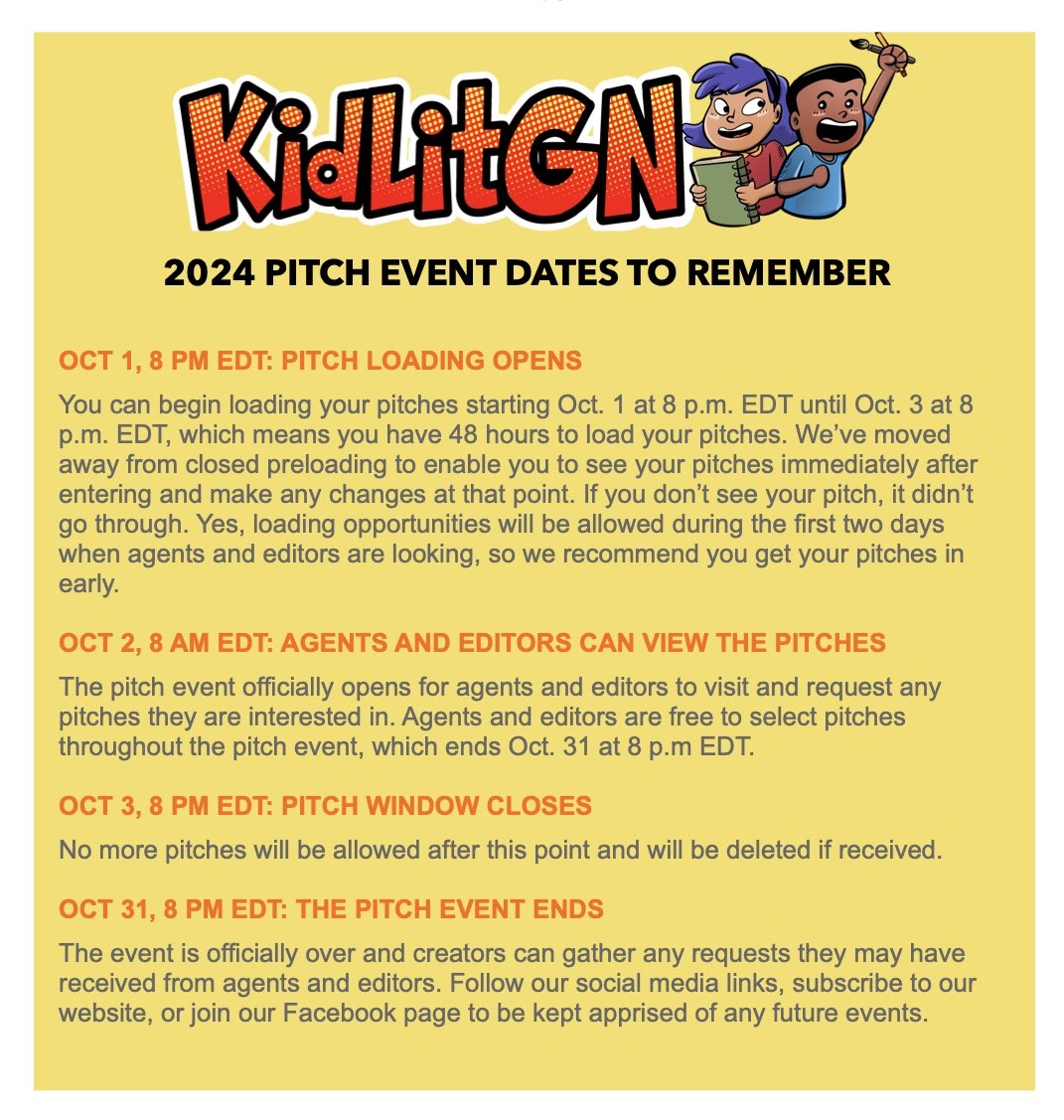
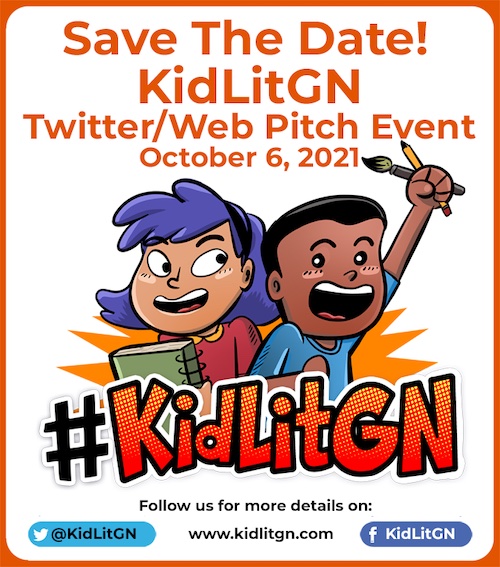
KidLitGN’s pitch event opened last night for loading pitches and this morning for agents, editors, and publishers to view and select pitches. GN creators still have until Oct. 3 at 8 pm EDT to load pitches. And agents, editors, and publishers can view pitches until Oct. 31 at 8 pm EDT.

See kidlitgn.com for details.

Also on KidLitGN’s blog, is a comprehensive Q&A from literary agent Janna Morishima, where she mentions the opportunity to join Kids Comics Studio–the membership part of Kids Comics Unite. The latter is free and open for joining year round. Kids Comics Studio, however, opens for new members at select times of the year (it’s open for a few more weeks) and has a monthly or yearly charge. Kids Comics Studio offers weekly workshops, critique and accountability sessions, networking with other graphic novel creators and a whole host of opportunities you won’t find anywhere else (see here for more details). I’ve been a member of Kids Comics Studio and have benefited from the community’s knowledge in countless ways, one of which leads into the third opportunity…

Some Kids Comics Studio members are putting together an anthology that we will be crowdfunding in April 2025. We’ve been hard at work coming up with a theme, planning our design, marketing, and of course, creating our comics. I’m collaborating with two amazing illustrators on two projects, which I’m hoping to share with you in the months ahead. And, we are rolling out our newsletter, where GN creators and other interested parties can join our journey through this process and learn what we have learned as we’ve collaborated to create this graphic novel. You can sign up for the newsletter at this link: https://bit.ly/kcu-studio-anthology

So there you have it, three opportunities to dive into the graphic novel creator’s world, KidLitGN’s pitch event, Kids Comics Studio, and the Kids Comics Studio Anthology newsletter.

You can access Janna’s amazing article here: https://kidlitgn.com/2024/10/02/what-are-agents-looking-for-a-qa-with-graphic-novel-agent-janna-morishima/

KidLitGN’s Pitch Event Opens this October!

October is just around the calendar corner and KidLitGN is hosting its annual graphic novel pitch event!

The event is for agented and unagented graphic novel projects for kids through YA. The categories include graphic novel-style picture books, early graphic novels, middle grade, and YA. There’s also a spot for graphic novel illustrators who don’t have a project to pitch but would like to pitch a sample from their portfolio.

To find out more, see the info graphic below or visit: kidlitgn.com. And spread the word.

Where’s Waldo?

I’ve disappeared these past two years, Waldo-like, into the landscape of boxes, paperwork, and the preparations of moving, changing jobs, and launching a child into the world. My time on this site has suffered. But I’ve been restless with all the changes and challenges of the past two years to get back into posting here and writing more in general. What writing time I have had has been spent revising stories that I haven’t yet polished to my satisfaction.

One is a historical fiction, middle grade novel that I started a lifetime ago. I’ve spent years researching it, and more years weaving my heart into it. It’s a tale with elements from my childhood and adulthood mixed with historical events, some of which I lived (yikes, it’s hard to think of one’s life as history already), so it takes an emotional toll to relive and honestly write about events that directly impacted me, but I’m ready to tackle it again.

Peel Castle, Isle of Man

I’ve had a middle grade, graphic novel script on the back burner as well, that’s itching to get out of me. It’s a Scorpio Races/Spirited Away mosh of a fantasy that’s taken me down a genealogical rabbit hole and inspired me to visit places where my ancestors lived and told stories of their own. It’s funny how stories that won’t let you go can evolve. This story started off as a picture book idea that I rewrote a thousand ways, until I realized it needed more than 32 pages to thrive. I tried writing it as a middle grade novel, but it’s always begged to be told in pictures, which spurred my interest in writing graphic novels. Once I got into writing graphic novels, which I already loved reading, I couldn’t stop. 

Continue reading

You’re Never Too Old or Too Late to Follow Your Dreams with Author PJ McIlvaine

PJ McIlvaine has been published in The New York Times and Newsday. PJ is also a regular contributor for the Children’s Book Insider newsletter, and a co-host of #PBPitch, a Twitter pitch party for picture book creators.

PJ has written across ages and genres, including a screenplay for Showtime which became the movie My Horrible Year. Her picture book, Dragon Roar, releases on Oct. 19, 2021 through MacLaren-Cochrane Publishing, Inc, which specializes in books for readers with dyslexia.

You’ve had quite a career in writing, including writing a movie for Showtime (which earned a daytime Emmy nomination, very cool). What has that been like and why did you switch to kidlit? 

Well, it’s like being on a roller coaster without a harness or safety belt. Sometimes you have to hang on and hope when the rides over, you haven’t broken every bone in your body. I consider myself a Jill of all genres when it comes to writing: I started out writing short stories, then poems, song lyrics, then eventually novels and screenplays but nothing in the kid-lit arena. Then my mother died (I was her caretaker for years), and I was now a grandma. I read picture books to the babies, and I realized hmmm, this was something I could write. So then I immersed myself fully in picture books, and soon graduated to middle grade and young adult. I have a good feel for kid lit—I cut my teeth on Nancy Drew and Trixie Belden growing up. So given where I was in my life, it was a natural evolution.   

Continue reading

It’s Been a While and Other Good Things

Art by Ken Lamug

I’ve been neglecting this site, but for good reasons. I’ve been busy as part of a team effort on the newest KidLit GN Pitch event, which is Oct. 6! Coming next week.

I’ve also been busy writing my own graphic novels and other work, some of which I’ll be pitching then as well, but I do have a new post coming soon.

For now, check out the details at https://kidlitgn.com if you are a graphic novel creator and are looking to pitch to agents or editors (agented and un-agented creators are welcome on the website pitch).

And check out the posts on the KidLit GN Blog for great advice on pitching and for a chance to win some awesome prizes, including classes, critiques, Kids Comics Studio membership and more.

Have a great week!

Voice p.2: World-building

Photo by Craig Adderley on Pexels.com

I previously discussed “Voice” as it applies to different age groups. Voice is the sum of your word choice, word order, beat, rhythm, and structure (see here for my favorite definition of voice).

Voice also creates your characters’ personalities, the mood, the setting, and your world. For this post, I’ll focus on the last one–world building. You can put the reader smack in the world of your story by using the right words for the right time, setting, and mood that your world resides in. 

For example, synonyms can create a different tone, even though, technically, they mean the same thing. Pa, Dad, Da, Pops, Papa, Father, all names for the male parent, but they each create a different world in the mind of the reader. 

Let’s apply this to various texts:

Continue reading

Graphic Novel Pitch Event

Yes, it’s been a while. Yes, I’ve been busy. We’re winding down the move-in part after another overseas move. A much more difficult transition in the days of Covid. However, I’ve also been hopping with other good things too, like helping to organize the event pictured above. We’ve got less than a week away and I’m beyond excited to participate.

So, if you’ve got a graphic novel ready to submit, plan on joining this event. And check out the event info on the website at: https://kidlitgn.blogspot.com

If you’re interested in creating graphic novels for middle grade and younger, join the group at: https://www.facebook.com/groups/KidLitGN

And to be notified of other pitch events, join the Twitter page at: https://twitter.com/KidLitGN

Happy writing!

Show, Don’t Tell with Author Karla Valenti

K headshotAs one of my critique partners, Karla has been a huge part of my writing journey. I can say with experience that she gives excellent and thorough advice. And luckily, she’s agreed to share some of that here, along with the chance to win her new picture book, Marie Curie and the Power of Persistence, a story about science and perseverance that’s definitely needed right now. See the details below on how to enter. In the meantime, enjoy Karla’s sage advice on how to show not tell.


Thank you, Karla!

Thanks for talking about this hard-to-pin-down topic of how to show not tell. With that, I’m going to turn the rest of this interview over to you to explain how to do this.

Johnell – thank you for inviting me on to your site and giving me a chance to launch my Show Don’t Tell blog series. I also appreciate the chance to share a little bit of information about my upcoming debut picture book “Marie Curie and the Power of Persistence.”

What is Show Don’t Tell?

I’ve been doing PB critiques for many years and have read hundreds of manuscripts. Time and again, the two things that come up most often in my feedback is the importance of structure and showing vs telling. Structure is fairly easy to understand, but showing is a lot more elusive and difficult to explain. I always find it easier to simply point out instances of showing (or telling) in my client’s work, and to analyze why those scenes worked (or not). Eventually, my clients begin to internalize these moments and acquire their own instinct for when they were showing vs telling. 

I’ve wanted to do something similar using books that have been published and are accessible to any reader. My hope is that by understanding (and assimilating) these tips, it will become more instinctive in our own work. Cover

I thought I’d start with my book since I know it pretty well. Also, when I wrote it, I was very deliberate about finding ways to show what I wanted to convey so it’s easier for me to point out those instances.

I do want to say, this is simply my opinion and readers are welcome to disagree. I do not claim to be an expert on this. However, to the extent this sheds some light on this very elusive but important storytelling rule, I hope it helps. Continue reading

Voice: “Your picture book sounds too old.”


In writing, you will hear about “voice,” but you won’t often get a clear answer as to what that means. That’s because it’s one name for many different things. It’s like saying “smurf” in the old Smurf cartoons—it means a different thing depending on how you use it.

I could address “voice” in a dozen different ways. I could talk about how each author is encouraged to find their own “voice”–how you can tell a poem by Emily Dickinson apart from Langston Hughes, for example. In singing, it’s the equivalent of knowing when Pavarotti is singing as opposed to Stevie Nicks. Each singer has a unique, recognizable style—you know their voice when you hear it.

I could also talk about your character’s voice, how we should be able to see as much of your character from what words they choose to use, what details they talk about (and what details they don’t). Does your villain speak in short phrases or long flowery ones? Does your main character repeat a specific word or phrase? Is your cowboy supposed to sound like Benedict Cumberbatch? This type of “voice” is a whole post all itself.

Continue reading