
The Let’s Go!: A Kids Comics Studio Anthology launches at 4 pm EDT on Kickstarter today! Click the “Notify me” button on our launch page to be kept up to date.
April 22 also happens to be Earth Day, and since the story that Cesar Lador and I collaborated on confronts the problems of space junk and ocean pollution, we wanted to share a little more information on how the story came about. What better way to do that than through an interview? How about two interviews?
The first is a video interview that the talented Sarah Giles prepared and edited, followed by a Q&A where Cesar and I interviewed each other.
And now the Q&A part.
My questions for Cesar:
When you get a script, how do you determine if it’s a right fit for you? Why did you agree to collaborate on Junk Wars?
Very good question! In the past I used to say yes to everything but, with time, I revised my approach and became more selective. The first element I consider is whether a story inspires me creatively or resonates with me, my values and beliefs. The second element is my current workload and the length of the script, I usually do a quick and very very rough storyboard to see how many pages it will take. For this anthology project, I wasn’t sure initially when I received the first draft but meeting on zoom and talking about the project showed me that you were open to suggestions and a real collaborative effort. It is also important to me that you were flexible and gave me freedom in the art department (characters, layout, design, etc.) and that we were well aligned in terms of personal values. I also knew that we were limited to a 8 page comic so I knew that it wasn’t going to be a huge investment of time.
What was your process in developing the comic?

Once we agreed on a story and had a script, my first step was to storyboard the entire comic to see how I could make it fit on 8 pages as this was one of our constraints. I started with a rough storyboard on paper and then refined it in Photoshop. I believe I submitted the storyboard to you for feedback, made a few changes and proceeded with tight pencils in Photoshop so it is easy to fit the art and the text together, move things around, re-size elements, etc. Once my pencil was satisfactory I printed all pages super transparent (barely visible) on watercolor paper to have the template, layout and art laid out on the page.

I inked the entire comic with black ink (brush pen and 0.3mm ink pens) and then I started to think about colors. I knew that I wanted 2 different color schemes for the two main parts of the story, I did some trials and completed a color script of the entire comic. A color script is a mini colored version of the comic, not focusing on the art but predominantly on the colors. Once I am happy with the color schemes, I paint with watercolors the pages that I have inked. There is no undoing with watercolors so it can be a bit overwhelming, I always keep in mind that I can start a page again or replace a panel or use Photoshop to tweak things up. Once the pages are all painted and dry, I scan them, import them in Photoshop and start experimenting with the lettering, the speech bubbles and the Sound FX. I do all of that in Photoshop.

What makes a successful collaboration?
To me, for a collaboration to work, each team member has to be flexible, listens and takes into consideration suggestions and feedback from others. Comic making takes a lot of time so you want to be happy to do it and not forced. It has to remain a joy for everybody involved.
What do you hope people take away from Junk Wars?
I think Junk Wars raises multiple questions and hopefully will allow kids and grown ups to have interesting conversations around us as humans, technology and our planet. This story obviously highlights some of the current and future challenges but also questions what our priorities are or should be. We tried to avoid being too moralizing but offer a subtle perspective of where we (the collaborators) think humanity’s focus should be.
Cesar’s questions for me:
Are you following a typical structure or template when you are writing a story (three act structure, hero’s journey, etc…)?
It depends on the story I’m telling. The historical fiction, middle-grade novel is in the editing phase and follows a story-circle plot. My middle-grade, graphic novel fantasy is a hero’s journey. I have a completed middle grade graphic novel script about a lonely boy and misfit duck who conquer a mutual nemesis and become friends that’s a three-act structure. My other completed middle grade script about a crab and turtle who are besties but get driven apart by some internet savvy seagulls follows a Fichtean Curve. So definitely depends on what the story needs.
How are you choosing what to write about?
So many things inspire me. The historical fiction mentioned above was inspired by events that happened near my hometown. The fantasy graphic novel was inspired by a trip down a genealogical rabbit hole that introduced me to places and mythologies my ancestors would have known, which inspired me to create my own myth as the basis for a story about a mysterious island and its inhabitants that still have a connection to the spiritual realm that many of my ancestors would have been familiar with.

“Junk Wars,” our short comic, was inspired by current events. As I say in the video, I was listening to the news on the radio about the critical mass of space junk orbiting our atmosphere and the threats it poses. We’re also in crisis with our oceans and all the junk we’re dumping in there that’s affecting marine life, so I wanted to combine those two stories. The idea of whales–space and marine–became a unifying image for me to tie the two atmospheres together, and I love the design of the space whales that you landed on.
What are the important factors to make a collaborative project successful?
Flexibility, listening, determination—it takes a lot of drive and commitment to work through the inevitable changes that come in a collaborative process. And also humility, an undersold virtue, but being open to different ways of thinking about a story element really helps when working with another person or a team of creators.
How do you choose a collaborator?
You and Maggie Shang are the first collaborators I’ve worked with on a story, but I’ve certainly collaborated on other projects, like KidLitGN, a graphic novel group that hosts a free pitch event, and the attributes I looked for in working with the team at KidLitGN are the same as choosing any collaborator. I look for someone who is flexible, professional, reliable, committed, and invested in the success of the project.
For our story, I looked at various art styles of potential collaborators and tried to pick a style that I thought would work for the story without necessarily choosing the obvious one, which was yours. I love what you’ve done with the story, and the the color palette changes between the two “worlds.”
How do you know that your script/story will fit on a limited number of pages (eg. 8 pages story for the anthology)?
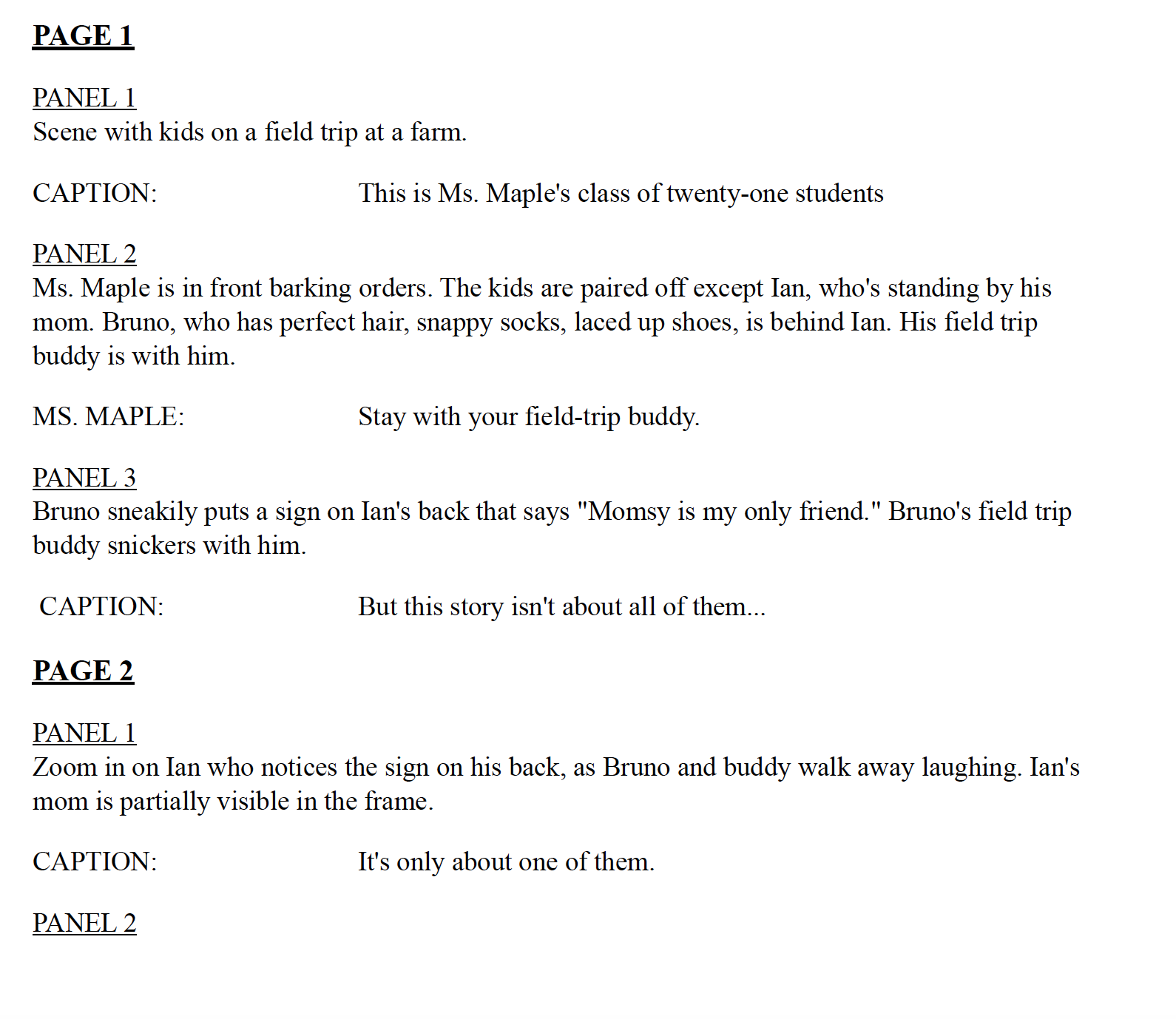
Great question. I will break my GN scripts into pages, panels, dialogue, etc. If I have a question as to whether or not something will fit, I’ll often do loose story boards—I’m not an illustrator, so they’re pretty hideous, but it helps me see if the text is too much or if the action needs more space. I don’t always get it right, but I do use a script format when I write to help me pace the action across pages and panels.
How many stories are you working on right now?
I’ve got a number of stories in various stages, but I’ve just started a lower YA paranormal novel that I’m really excited about, so I guess if you pinned me to a number of stories currently being written or edited, I’d say four.
That’s a wrap for now, but stay tuned for a lot of info coming your way, including an interview I did with my other collaborator, Maggie Shang, and Barney Smith at Story Comics.
In the meantime, enjoy our short Earth Day clip and follow us on Kickstarter!
 johnell dewitt
One thought on “Junk Wars is on Kickstarter!”